Creatine Before or After a Workout? Get the Facts Straight.
-
Andra Picincu
Gone are the days when creatine was used largely by powerlifters and bodybuilders. This dietary supplement is now a staple among gym-goers of all ages and fitness levels, with ongoing research exploring its potential benefits for brain health.
But should you take creatine before or after a workout? While consistency matters more than timing, taking creatine after exercise may offer a slight advantage in terms of body composition and strength gains.
Post-workout supplementation is also more suitable for people who experience digestive discomfort or bloating, as these side effects are less likely to interfere with their training. Plus, it’s easier to pair creatine with carbohydrates post-workout, especially if you train on an empty stomach or consume most of your daily carbs after exercise.
That said, let’s talk about creatine timing and its effects on workout performance, muscle strength, recovery, and digestion.
Does Creatine Timing Matter?
Most gym-goers take creatine to build muscle and strength, boost workout performance, and recover faster from training. This compound helps replenish adenosine triphosphate (ATP), the body’s primary energy source, allowing muscles to sustain repeated bouts of high-intensity exercise with less fatigue.
The question is, should you take creatine before or after a workout to reap these benefits? Let’s start with a quick breakdown of how your muscles store and use this nutrient.
Your body produces about 1 gram of creatine per day from three amino acids: glycine, arginine, and methionine. A diet rich in meat and fish supplies roughly another gram.
Supplementing with 3 to 5 grams daily helps increase muscle creatine stores, supporting gains in lean mass, strength, and power. Getting 5 grams of creatine from food would require consuming about 4 to 5 pounds of meat per day, which simply isn’t realistic.
That said, several factors influence creatine absorption and uptake:
- Absorption time: After ingesting 5 grams of creatine, plasma creatine levels can take up to two hours to peak. They remain elevated for up to four hours, influencing creatine availability for muscle uptake.
- Blood flow: Exercise boosts blood flow to your muscles, which may increase creatine absorption for 30 minutes or longer after training, depending on workout intensity.
- Carbohydrate intake: Pairing creatine with carbs increases its uptake by muscle cells. Carbohydrates stimulate insulin release, facilitating creatine transport into muscle tissue.
Based on these factors, the best time to take creatine is before or after training.
Still, research suggests that post-workout supplementation might be more beneficial because that’s when muscle blood flow and nutrient uptake are higher.
Should You Take Creatine Before or After a Workout? What Science Says
Taking creatine daily ensures your muscles stay saturated. Timing matters less as long as you’re consistent with your supplementation.
From a scientific standpoint, there are valid reasons to take creatine before exercise and valid reasons to use it post-workout. Here’s what the evidence says about each approach.
Does It Make Sense to Take Creatine Before Training?
Since many pre-workout formulas contain creatine, you might think creatine supplements are best taken before hitting the gym. However, that’s not necessarily true.
Creatine reaches peak levels in the bloodstream within two hours or so. Exercise increases blood flow to your muscles for several hours after training.
Therefore, taking creatine one to two hours before your workout aligns with peak blood creatine levels, offering pretty much the same benefits as post-workout supplementation.
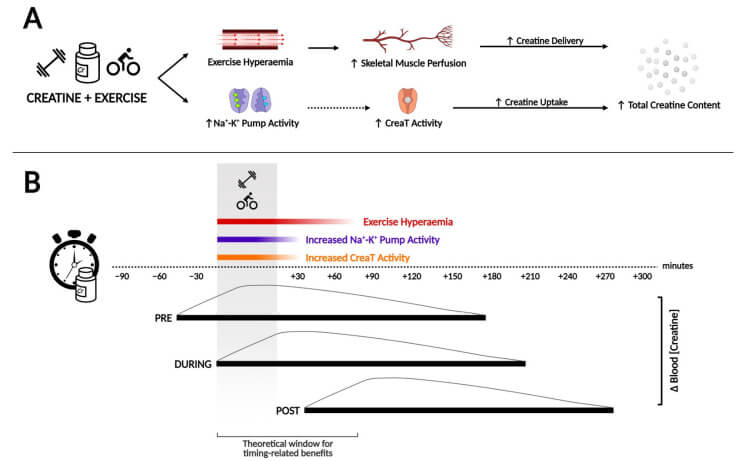
Source: Ribeiro F, Longobardi I, Perim P, Duarte B, Ferreira P, Gualano B, Roschel H, Saunders B. Timing of Creatine Supplementation around Exercise: A Real Concern? Nutrients. 2021 Aug 19;13(8):2844. doi: 10.3390/nu13082844. PMID: 34445003; PMCID: PMC8401986.
A 2021 review published in the journal Nutrients supports these findings. While some studies have reported small advantages for pre- vs. post-workout creatine supplementation, those differences become negligible when larger groups and longer periods are considered.
Arguments for Taking Creatine Before Exercise
There are a few reasons why some people prefer taking creatine before training:
- Support for high-intensity exercise: Creatine helps replenish ATP through the phosphocreatine system, supporting power output during short, high-intensity activities like weightlifting, sprinting, and HIIT. However, these benefits come from maintaining adequate muscle creatine stores rather than from supplementing immediately before exercise.
- Increased muscle hydration: Creatine draws water into muscle cells, making your muscles appear slightly fuller. However, an increase in intracellular water doesn’t necessarily translate into better hydration or enhanced workout performance.
- Support for repeated high-intensity efforts: By increasing muscle phosphocreatine availability, creatine can help support repeated bouts of high-intensity exercise. To achieve this effect, you need to maintain adequate muscle creatine stores over time rather than simply take creatine before training.
None of these arguments is strong enough to give pre-workout creatine a clear advantage. Taking creatine before exercise can make it easier to stay consistent, but even that depends on your routine.

The Case for Post-Workout Creatine Supplementation
Creatine may cause bloating and digestive discomfort, especially during the loading phase. In a clinical trial, nearly 80% of participants experienced gastrointestinal symptoms, with severity being dose-dependent. These effects tend to be more common in women and individuals with digestive disorders, such as irritable bowel syndrome (IBS).
That’s one reason I recommend taking creatine after exercise. If you have a sensitive stomach, the last thing you want is to feel like a walking balloon or need a bathroom break mid-workout.
Leaving this aspect aside, taking creatine after training may be more effective for building lean mass and strength. A likely explanation is that exercise increases blood flow to working muscles, potentially enhancing creatine delivery and uptake.
However, the research on post-workout creatine supplementation is rather thin. To date, only a few studies have been conducted, and most involved relatively small numbers of participants.
Ideally, take creatine around your workouts and continue supplementing on rest days. Whether you have it with your post-workout snack or before you head to the gym is largely a matter of personal preference.
The key factor isn’t timing but consistency.
Arguments for Taking Creatine After Exercise
Post-workout creatine may be more convenient in certain situations. For example, if you train on an empty stomach, you can take it with a meal or snack afterward and still reap the benefits.
Other reasons you might prefer post-workout timing:
- Your muscles are more receptive to nutrients after exercise.
- If creatine upsets your stomach, you won’t have to deal with it while training.
- It’s easy to pair with your post-workout meal, snack, or protein shake so you don’t forget your daily dose.
- When taken with carbs, creatine may increase muscle glycogen after a workout and speed up recovery—though you’d get similar benefits by consuming it with carbohydrates before exercise.
- Post-workout timing can also work well if you train during your fasting window.
Pure, unflavored creatine monohydrate mixed with plain or sparkling water doesn’t break an intermittent fast. So, if your fasting window overlaps with your workout, you can take it before, during, or after exercise.
Flavored creatine powders, pre-workout blends, and gummies are a different story. They may contain sugar, carbs, or fillers that provide calories and can break your fast.
If you’re using such products, it’s best to save them for your eating window—whether that’s before or after your workout.
How Much Creatine Should You Take Daily?

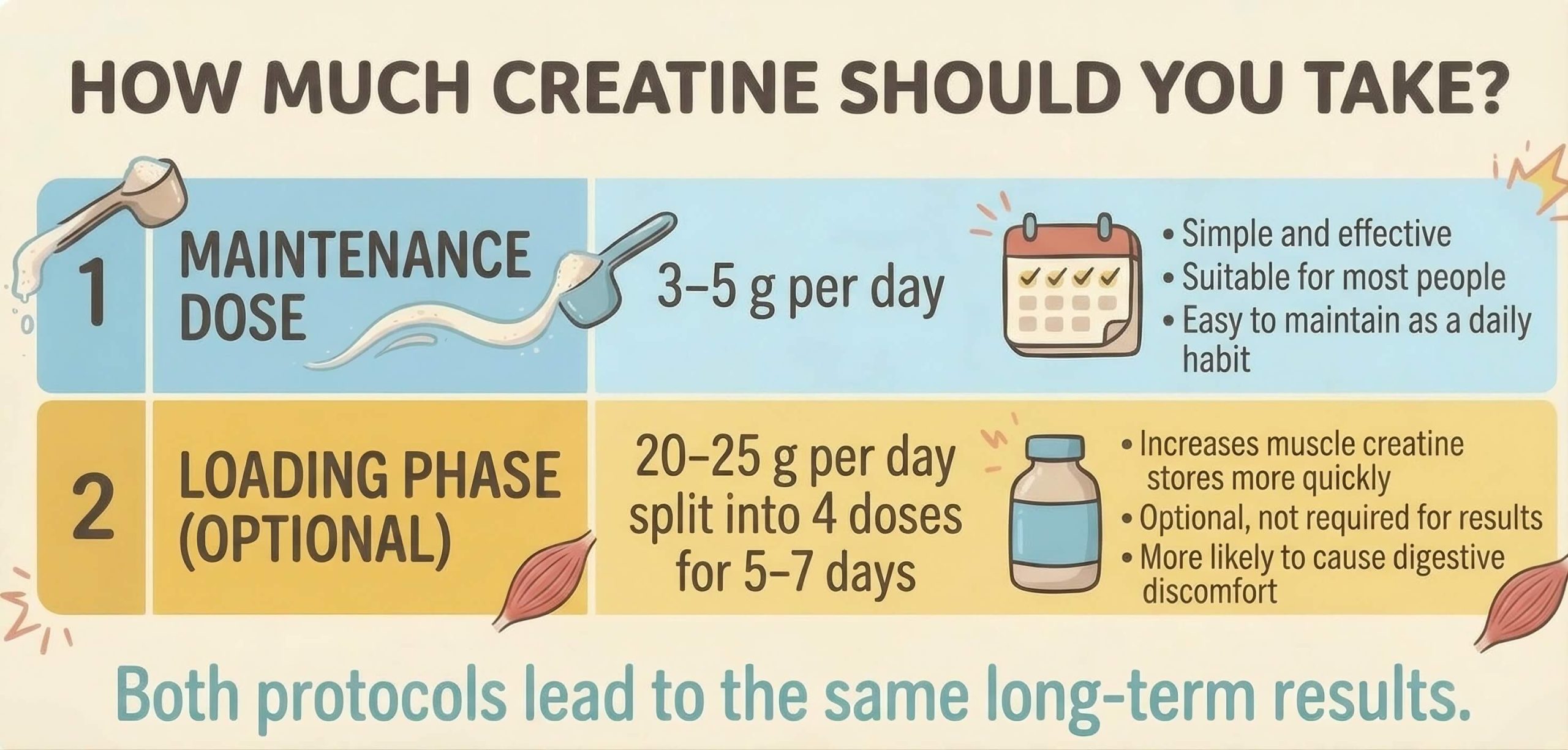
Whether you take creatine before or after a workout, aim for 3 to 5 grams per day, or 0.1 grams per kilogram of body weight. So, if you weigh 190 pounds (~86 kg), your daily dose would be around 8 grams.
A common practice is to start with a loading phase of 20 to 25 grams per day, divided into four or five doses, for five to seven days. After that, you switch to a maintenance dose of 3 to 5 grams per day.
However, loading doesn’t produce better results in the long run. It simply saturates your muscle creatine stores faster.
With a daily dose of 3 to 5 grams, it takes roughly three to four weeks to reach a similar level of saturation. Once your muscles are saturated, both approaches produce comparable results over time.
So, should you load creatine or skip this step?
Realistically, loading is worth considering only if you want to maximize the performance benefits of creatine within a very short timeframe—for example, if you’re preparing for a competition or another high-intensity athletic event.
How to Maximize the Effects of Creatine
Creatine is more or less effective depending on your diet, workout routine, and how you use it. Take these steps to maximize its benefits:
- Be consistent: Take creatine daily, including on rest days, to keep your muscle creatine stores saturated. This approach can speed up recovery and facilitate muscle growth.
- Pair creatine with carbs or protein: Taking creatine with carbs, or a combination of carbs and protein, may improve its uptake into muscle cells. For example, you can mix it into a post-workout protein shake with a small amount of dextrose or have it with a bowl of oat bran, a higher-fiber alternative to oatmeal.
- Go for micronized creatine: Due to the smaller particle size, micronized creatine dissolves more easily in liquid. It isn’t necessarily more effective for muscle growth or performance, nor does it work faster than standard creatine, but it can be gentler on your stomach.
- Drink plenty of water: Creatine draws water into your muscle cells, which contributes to muscle volume and can boost workout performance. Staying properly hydrated supports this process and helps your body deliver nutrients to your muscles.
- Don’t overdo it: Once your muscles are saturated with creatine, taking higher doses won’t provide additional benefits. At that point, excess creatine is filtered and excreted in urine.
As a final consideration, look at your overall diet.
Creatine concentrations are lower by about 50% in plasma, 35–39% in serum, and 27–50% in red blood cells in vegetarians compared to individuals who regularly consume animal products. Vegans and people who eat little or no meat or fish tend to have lower muscle creatine levels, too.
When someone starts with lower baseline muscle creatine stores, supplementing allows muscles to absorb and retain a significantly higher percentage of the intake compared to omnivores. This can translate into greater gains in power, strength, and workout performance.
Can You Take Creatine and Caffeine Together?
You might have heard that taking creatine and caffeine together before a workout boosts physical and mental performance more than caffeine alone. These supplements don’t cancel each other out, but some studies suggest that caffeine may diminish creatine’s effectiveness.
One explanation involves muscle relaxation time (MRT). Creatine shortens MRT, which may support force production, while caffeine increases the time it takes a muscle to relax after contracting. Caffeine may also affect the creatine transporter, a protein that moves creatine into muscle cells.
That said, the evidence on creatine and caffeine is mixed, so there’s no need to avoid the combination altogether. If you’re sensitive to caffeine or want to get the most predictable response from your creatine supplement, you may prefer to take them separately.
Creatine Timing Matters Less Than You Think
So, should you take creatine before or after a workout? In this case, consistency beats timing. Both pre- and post-exercise creatine intake can be effective as long as you stick to it.
Mix 3 to 5 grams of micronized creatine into a protein shake, smoothie, mass gainer, or plain water—and have it when it fits your schedule. That could be first thing in the morning, before hitting the gym, halfway through your sets, or after your shower.
One thing to keep in mind is that creatine on an empty stomach may cause digestive upset. If you experience bloating, gas, or other gastrointestinal symptoms, take it with a meal or snack anytime throughout the day. Increasing your fiber intake could help, too.
I supplement with creatine after exercise, but that’s a matter of personal preference. Creatine works by gradually increasing and maintaining muscle creatine stores, so it’s not necessary to time each dose.
Do whatever is most convenient for you—and make it a habit.
A Note About AI: Some images on Shape Your Energy are created with the help of AI, and I may occasionally use AI tools to refine parts of the text for clarity, flow, or readability.
The content itself is written by me, based on my professional knowledge, experience, research, and original ideas. I don't use AI to generate my articles or replace my own expertise and judgment. Any AI-assisted edits are reviewed and adapted by me before publication.
Creatine Timing FAQs
The exact timing doesn't matter much as long as you take creatine daily. Unlike caffeine, creatine doesn't work immediately. Instead, it gradually builds up in your muscles over time. Whether you take it before, during, or after your workout, the benefits are largely the same.
Taking creatine on rest days ensures your muscle creatine stores stay full. Since your body continues to use energy at rest, keeping your creatine stores topped up aids in cellular repair and post-workout recovery.
Yes, you can take creatine with tea, juice, smoothies, and other beverages. Caffeine may blunt some of its benefits, so if you want to play it safe, take creatine a few hours before or after your coffee.
Yes, taking creatine before bed is perfectly fine and shouldn't interfere with sleep. Creatine isn't a stimulant and doesn't provide the energizing effects associated with pre-workout supplements or caffeine.
However, if you're using a pre-workout formula that contains creatine alongside ingredients like caffeine or yohimbe, it could make it harder to fall asleep. In that case, it's the stimulant ingredients, not the creatine, that are likely responsible.
Not at all. Taking around 20–25 grams of creatine per day for five to seven days can saturate your muscles faster, but taking 3–5 grams daily will produce a similar level of muscle creatine saturation in the long run.
You don't need to drink extra water just because you're taking creatine. Just make sure you stay hydrated throughout the day and drink enough fluids to support your activity level.
If you're following a creatine loading protocol or training in hot weather, increase your fluid intake as needed. In those situations, aiming for roughly 3 to 4 liters (100 to 135 fluid ounces) of water per day can help maintain hydration.
Remember that creatine draws water into muscle cells, so staying hydrated supports muscle function and overall performance.
A good rule of thumb is to monitor your thirst and urine color. Pale yellow urine generally indicates adequate hydration.
For most women, 3 to 5 grams of creatine monohydrate per day is enough to maintain healthy muscle creatine stores and support workout performance. This dosage has been widely studied and is considered both effective and well tolerated.
Research in postmenopausal women suggests that taking 5 grams daily alongside resistance training can help increase muscle mass and strength. As with men, consistency is more important than timing, so aim to take creatine every day, including on rest days.
Unless you're following a short-term loading protocol, there's generally no need to take more than 5 grams per day.
Creatine can cause a small increase in body weight, especially during the first days or weeks of supplementation. This initial weight gain comes from water stored inside your muscle cells, not from body fat. When combined with strength training, creatine may also help you build lean mass, which can nudge the scale up a bit more.
Yes, creatine is considered safe for healthy adults when used at the recommended doses. While some people may experience mild side effects, such as temporary water retention, bloating, or digestive discomfort, these effects are generally short-lived and often improve with lower doses or continued use.
However, creatine may not be appropriate for everyone. If you have kidney or liver disease or take medications that affect kidney function, fluid balance, or blood sugar levels, speak with your healthcare provider before supplementing.
There is also limited evidence suggesting that creatine could trigger hypomanic or manic symptoms in some individuals with bipolar disorder. This side effect may be due to its ability to boost brain energy metabolism and mitochondrial function.
Missing one day of creatine is unlikely to make a difference. Muscle creatine stores decline gradually over time, so you don’t need to double your dose to make up for a missed day. Even if you skip a week, your stores won't be depleted if you've been taking it consistently. Just pick up where you left off.
When you stop taking creatine, your muscle creatine stores return toward their baseline level over the following weeks. The extra water stored inside your muscle cells will also gradually decrease, which may cause some of your body weight and muscle fullness to drop. This doesn't mean you've suddenly lost the muscle tissue you built while training.
Yes, you can take creatine even if you don't work out or play sports, but you won't get the same results as you would with exercise. This dietary supplement supports cognitive performance, brain function, and overall health, regardless of your activity level.
According to a recent study, creatine may help increase lean mass and strength even without exercise. Middle-aged adults who took 10 grams of creatine monohydrate daily for 12 weeks gained about 2.4 pounds of lean mass and got stronger on the leg press and bench press without following a training program.