
Back Hyperextension: Good or Bad for Lower Back Pain?
-
Andra Picincu
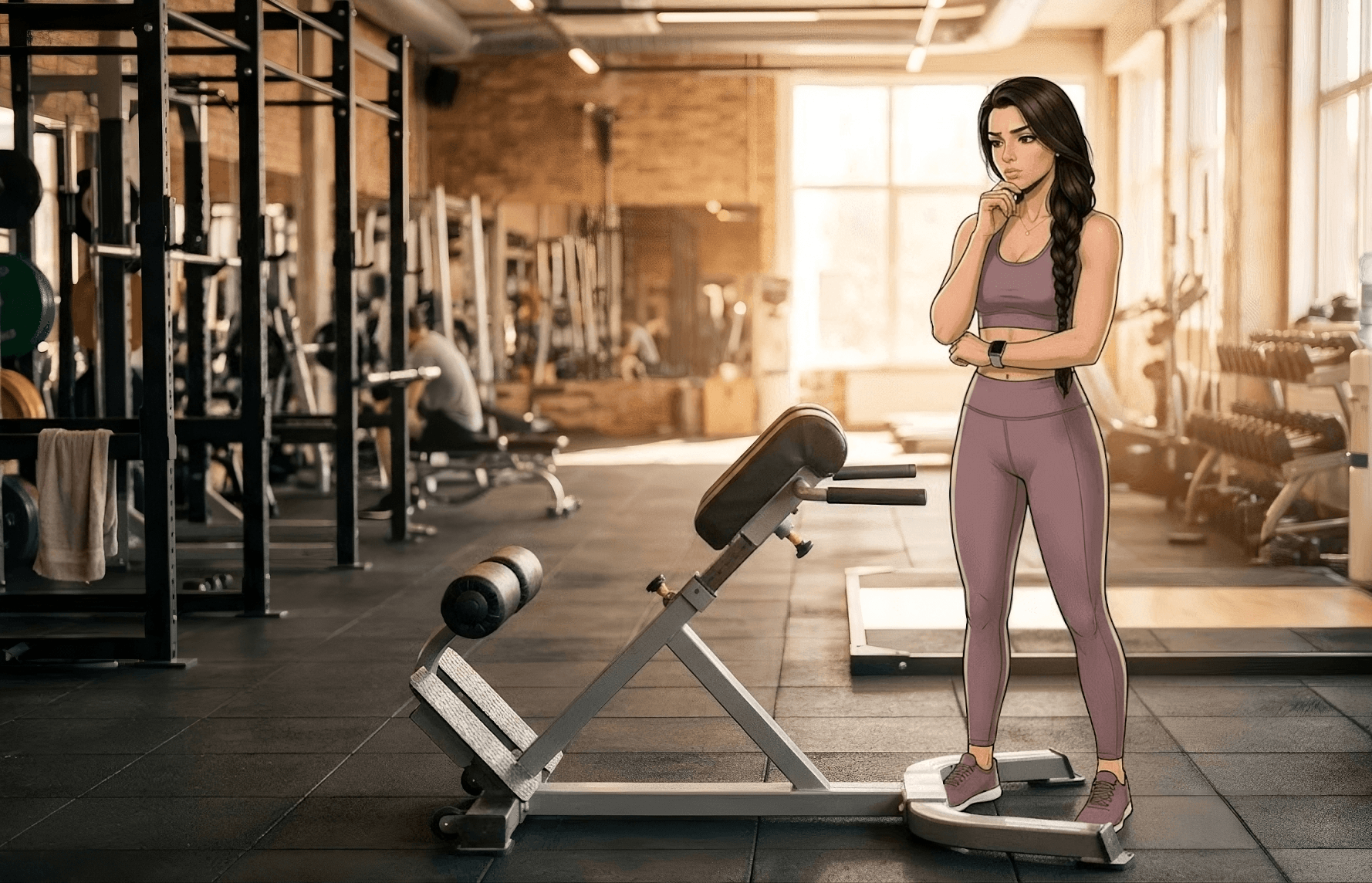
The back hyperextension might be one of the most underrated exercises for lumbar pain. While it’s often recommended for strengthening the posterior chain, it doesn’t get enough credit for calming a cranky lower back. One reason is that most people never learn to do it correctly.
Love them or hate them, hyperextensions can improve posture, decompress the spine, and counteract the dreaded “desk hunch.” They also boost spinal mobility, making everyday movements easier.
I’ve been living with chronic lower‑back pain for years, and the hyperextension remains at the top of my list. Here’s why this exercise is worth your attention, how to perform it safely, and a few alternatives if you don’t have access to a back‑extension machine.
Why Back Hyperextension Has a Bad Reputation
There’s a lot of conflicting information about whether the back hyperextension is good or bad for your spine. Some experts label it “risky” and lump it in with sit‑ups, toe touches, and other exercises to avoid with lower back pain. Others swear by it for pain relief and prevention.
The truth sits somewhere in the middle. Hyperextensions can help or harm, depending on your technique, range of motion (ROM), load, and how your back feels on any given day.
💡 Quick Clarification: In this context, "hyperextension" doesn't mean forcing your spine past its natural limits. The goal is to raise your torso until it's in a neutral, straight line with your legs—not to keep arching backward.
Most horror stories come from people who were taught (or assumed) that more ROM equals more benefit. It doesn’t.
Once you move past neutral, you’re placing unnecessary stress on the lumbar spine in a position it’s not designed to control under load. That’s when irritation and discomfort are more likely to creep in.
Here are a few other reasons the back hyperextension got a bad reputation:
- Momentum replaces control: Swinging your body or bouncing at the bottom shifts the load off your posterior chain and onto your passive spinal structures, such as ligaments and discs, instead of the muscles built to handle it. This common mistake can increase stress on your lower back.
- Poor setup or technique: Letting your back round excessively, arching past neutral at the top, or positioning the pad too high forces the spine to flex or extend under load. You might not feel pain immediately, but repeated stress adds up over time.
- Lifting too heavy: Even with perfect form, you can still irritate your spine by piling on too much weight. For example, holding a 45-pound plate to your chest might feel like progress, but if it makes you strain through the last few reps or round your back on the way down, the added load is working against you.
- Training through pain: Hyperextensions are not ideal during a flare-up. A rushed, high-rep set done on a day when your back is already irritated can worsen pain and stiffness.
The exercise itself isn’t the problem. Most issues stem from poor technique, excessive loading, or failure to maintain a neutral spine.
What Makes Hyperextensions So Effective for Lower Back Pain
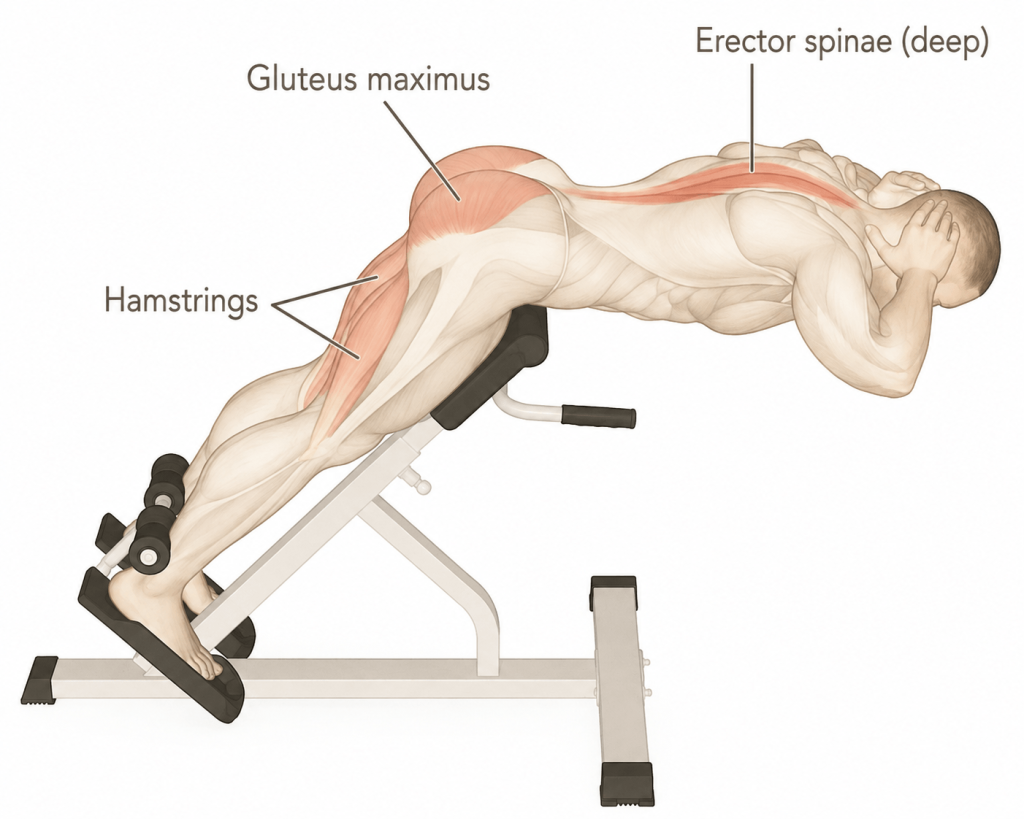
If you struggle with lumbar pain, the back hyperextension might be the last exercise you’d expect to help. After all, bending backwards doesn’t sound like the best idea when your back already hurts. Yet, when done correctly, it’s one of the most effective ways to strengthen the muscles that support your spine, which can help reduce stiffness and improve ROM.
Back hyperextensions target the erector spinae, glutes, hamstrings, and stabilizing muscles, such as the abdominals. The erector spinae is a large muscle group running along both sides of your spine. It consists of the iliocostalis, longissimus, and spinalis, three muscles that allow you to:
- Stand and sit upright
- Bend forward and to the side
- Maintain good posture
These muscles, called the spinal extensors, stabilize your spine every time you bend over, lift groceries, pick something up from the floor, or get out of a chair. They also control the movement as you lean forward, preventing your spine from collapsing under load.
When they’re weak, everyday activities become harder on your back. Over time, that weakness can contribute to pain, stiffness, reduced spinal mobility, and increased injury risk.
The back hyperextension can strengthen the spinal extensors, improving functional fitness. Simply put, it enables your spine to better handle the physical demands of daily life, from lifting heavy objects to sitting at a desk for hours.
What the Science Says
Clinical research supports the benefits of back extension training. Studies on lumbar extension exercises consistently show improvements in muscle strength, spinal mobility, and pain reduction, even with minimal training frequency.
Here are three key findings.
Dynamic Back Extensions Improve Lumbar Strength and Mobility
A 2013 study published in the Journal of Physical Therapy Science found that performing a dynamic back‑extension exercise three times per week for 10 weeks led to significant improvements in lumbar muscle strength and spinal range of motion (ROM).
Participants increased their L5–S1 extension ROM by an average of 24.73% and their T12–L1 extension ROM by 14.37%— a notable improvement given the short time frame.
The study was conducted on young women, but as the authors note, this type of training can help prevent age-related decline in spinal ROM and improve overall back function in the general population. Basically, strengthening the lumbar extensors may help maintain a healthy, mobile spine, regardless of age.
Isolated Lumbar Extension (ILEX) Eases Pain and Protects the Spine
Some of the most compelling evidence comes from a 2025 review of eight studies assessing isolated lumbar extension (ILEX) training. The studies involved men and women with nonspecific low back pain, most of whom did just one weekly training session—a single set of 8 to 12 reps performed to failure.
ILEX significantly decreased pain intensity, largely due to improvements in spinal stability and posture. It also increased muscle size and strength, which may help reduce mechanical strain on spinal structures over time.
Surprisingly, just one training session per week was enough to stimulate neuromuscular adaptations, such as greater motor unit recruitment and improved coordination, without overloading the muscles or worsening pain.
This type of high-intensity, low-frequency regimen also appears to trigger favorable biochemical changes: a reduction in pro-inflammatory cytokines and a boost in endorphin production, both of which can directly influence pain perception.
Pelvic Stabilization Boosts Muscle Activation
Another study found that lumbar‑extension training works best when the pelvis is stabilized. Under these conditions, it increases activation of the deep spinal muscles responsible for stability and pain reduction. The hyperextension bench offers partial pelvic stabilization, which helps target those muscles when the exercise is performed with proper form.
While the above studies didn’t specifically test the back hyperextension machine, they examined the same movement pattern. So add this exercise to your workouts, whether you’re training at home or at the gym, to build lower back strength and ease lumbar pain.
How to Do Back Extensions Safely
This old-school move is one of the best lower back exercises, but it’s easy to get wrong and end up in pain. The correct technique depends on whether you use a back hyperextension bench, glute-ham raise machine, stability ball, or just your body weight.
Let’s start with the back hyperextension bench, which you’ll find in most gyms. There are two main ways to perform the exercise:
- Glute-centric: Keep a slight curve in your upper back and drive through your hips until your body forms a straight line. This variation shifts more of the work to your glutes.
- Erector-centric: Allow a small, controlled arch or rounding of the upper‑to‑mid spine at the bottom, then extend fully. Choose this option to target the erector spinae and build lower‑back strength.
Now follow these steps to do an erector-centric back extension safely:
Setup
- Adjust the pad so it sits about 2-3 inches (5-8 cm) below your hip crease—not against your stomach or thighs. If it’s too high, you won’t be able to hinge properly. Too low, and you’ll lose the support you need.
- Place your feet firmly against the footplate, with your ankles secured under the rollers.
- Cross your arms over your chest for the beginner version. As you get stronger, hold a weight plate or kettlebell against your chest to increase the challenge.
Hyperextension Instructions
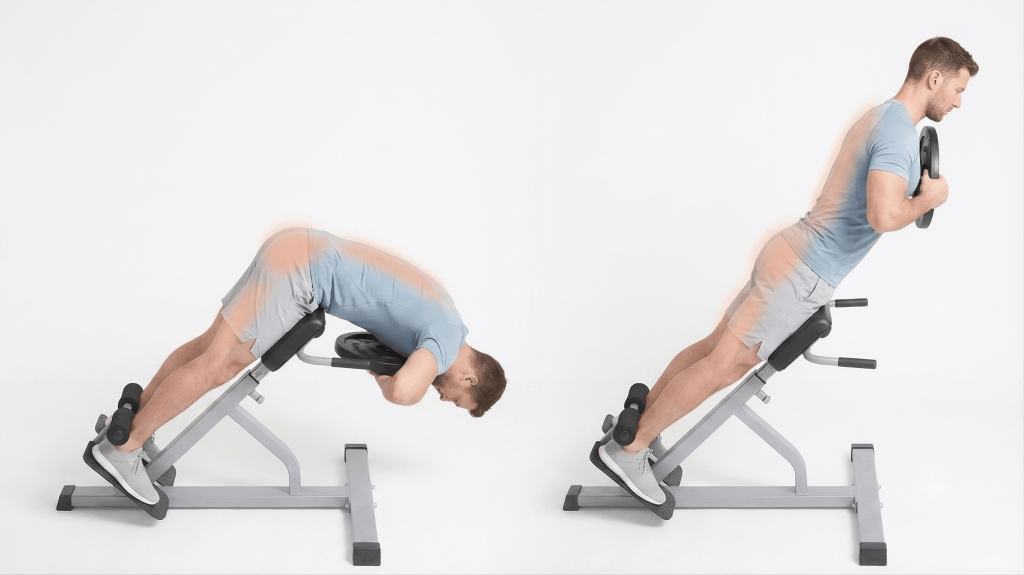
- Start with your torso bent forward at the hips, keeping your spine in a neutral, straight line (not rounded). If you feel a stretch in your lower back rather than your hamstrings, you've gone too far into flexion—pull back slightly.
- Extend your hips to raise your torso, squeezing your glutes as you come up. Lead with your hips, not your lower back. Keep a slight bend in your knees to prevent hyperextension. A helpful cue: think "push my hips into the pad" rather than "lift my chest." This subtle shift places the load on your glutes and hamstrings, reducing unnecessary stress on your lumbar spine.
- Exhale as you rise. Holding your breath under load increases intra-abdominal pressure, which can strain your lower back.
- Stop when your body forms a straight line from head to heels. Resist the urge to keep lifting past this point.
- Pause briefly, then inhale and lower back down under control, taking 2-3 seconds to return to the starting position. Most folks rush this part since gravity is doing the work, but slowing down the eccentric (lowering) phase is where much of the strength and stability benefit comes from.
I usually do four sets of 15 reps each, but these numbers aren't set in stone. Aim for three to four sets of 10-15 reps (or up to 20 reps with bodyweight only), depending on your fitness level. If you're adding weight, choose a load that allows you to maintain perfect form from the first rep to the last.
Hyperextensions work well at the end of a leg or back session, though you can slot them into any strength workout. It's a matter of personal preference.
Once you're done, spend a few minutes on static stretching and gentle soft-tissue work to help your muscles relax. If you need guidance, here's a practical breakdown of how to use a foam roller for back pain.
45° vs. 90° Back Extension: Which Angle Is Right for You?
Most hyperextension benches let you adjust the angle, and that choice actually changes what the exercise does for your back.
- 45° back extension: Puts more emphasis on the hamstrings while still strengthening the lower and mid-back. A solid choice if you want to open up tight hamstrings alongside building lumbar strength.
- 90° back extension: Shifts more of the load onto the glutes and lower back, with less hamstring involvement. This steeper angle is often recommended for rebuilding strength after a lower back injury or working through longstanding lower back pain, since it isolates the lumbar extensors and glutes more directly.
If your goal is general lumbar strength and resilience, the 45° version is a great all-around choice. If you’re specifically working to rebuild strength after an injury or flare-up, the 90° variation may target the muscles you need most.
No Hyperextension Machine? Try These Alternatives
No hyperextension bench? No problem—you can still train the same muscles with basic equipment or just your body weight.
Beware that these variations don’t offer the same stability or ROM as a dedicated back extension machine. Think of them as useful alternatives, not complete replacements.
Flat Bench Back Extension
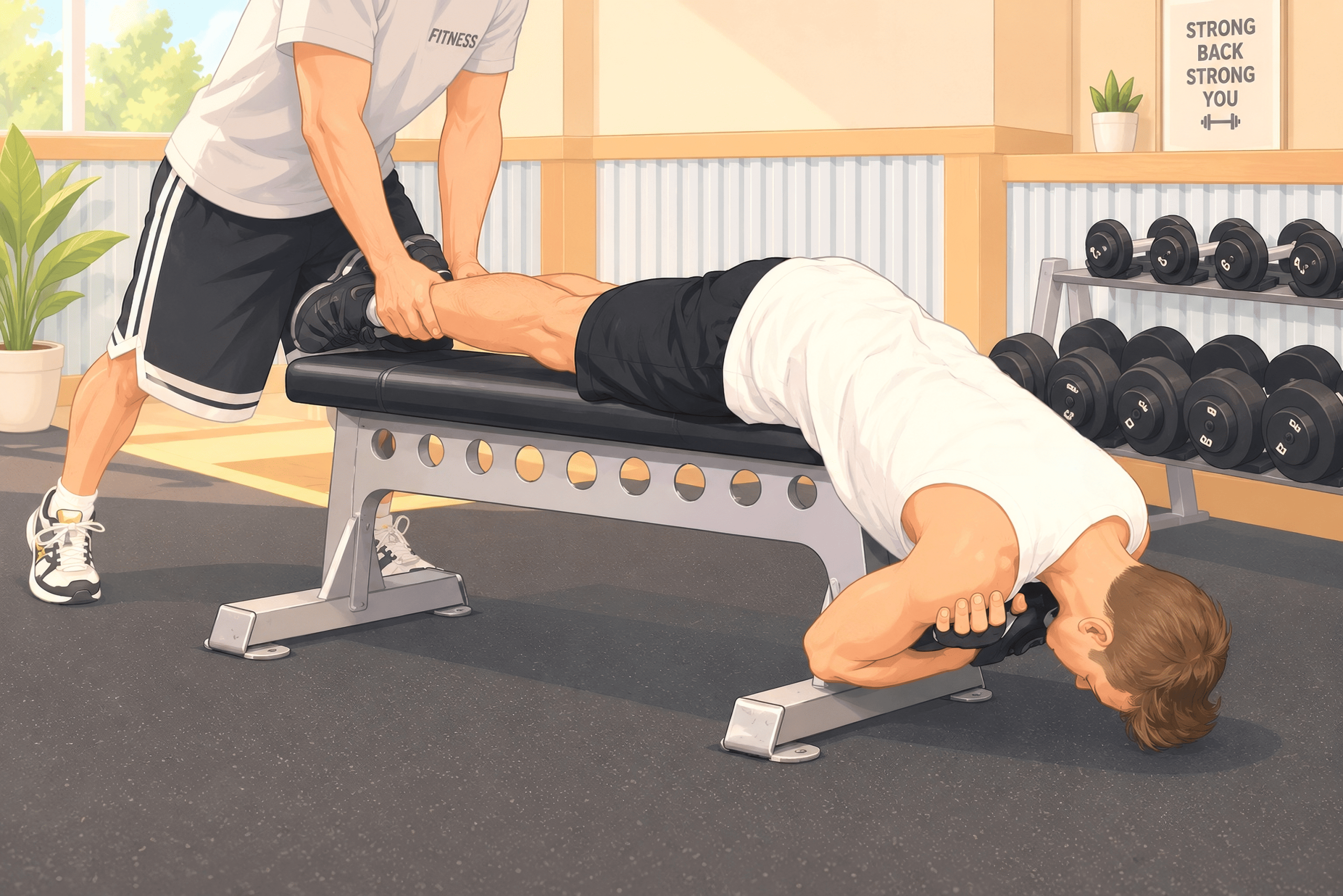
This is the closest substitute to the machine version, using a sturdy flat bench instead of a padded hyperextension bench.
- Lie face-down on a sturdy bench, with your hips at the edge and legs extended.
- Anchor your feet by having a partner hold your ankles or tuck them under a heavy piece of furniture.
- Hinge forward at the hips until you feel a gentle stretch in your hamstrings or lower back.
- Slowly raise your torso by extending your hips and squeezing your glutes. Follow the same cues as the machine version: lead with your hips, exhale as you rise, and stop when your body forms a straight line.
- Lower yourself slowly, taking 2-3 seconds to return to the starting position.
Stability Ball Back Extension
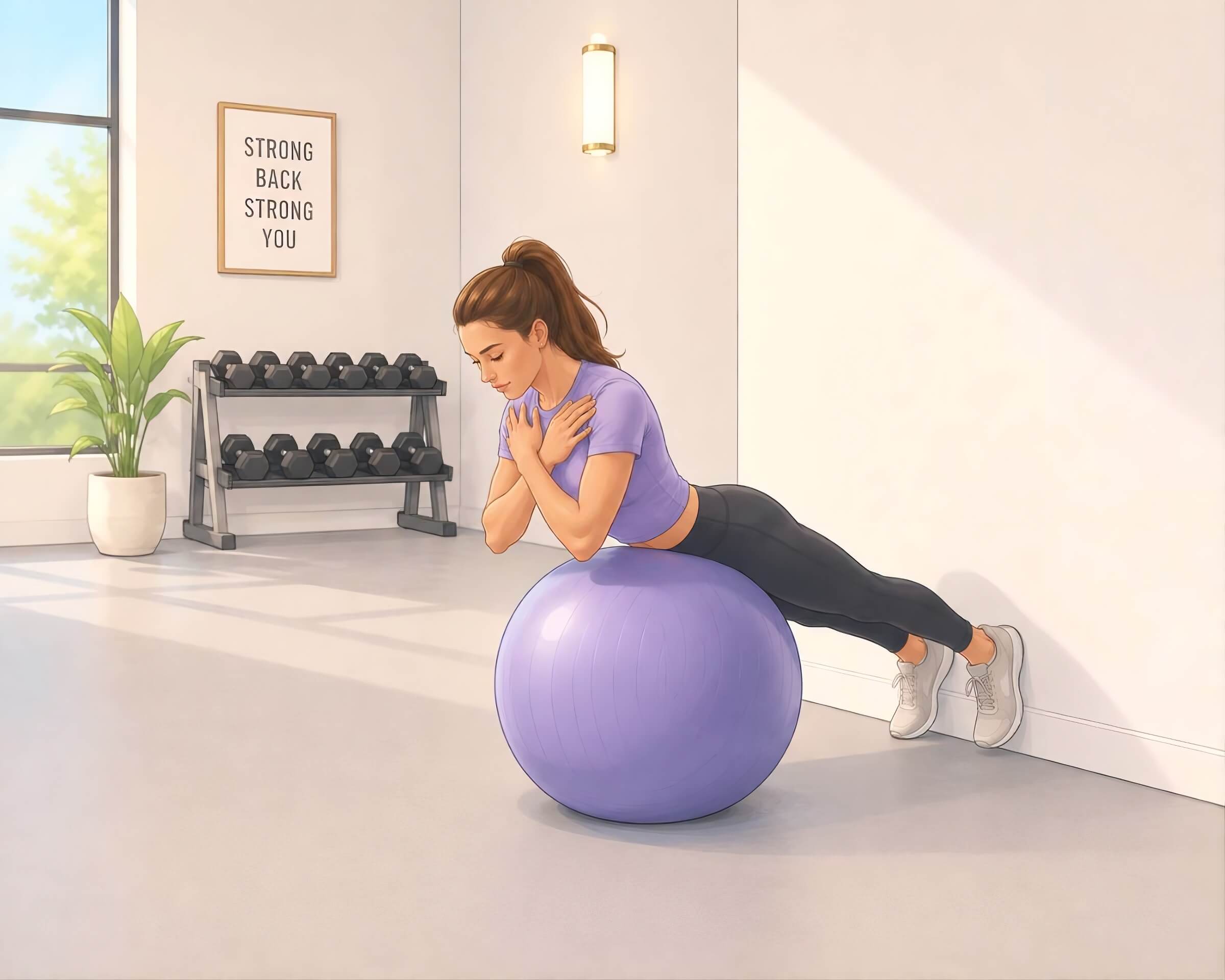
Since the ball moves beneath you, your core and stabilizing muscles have to work harder to keep you balanced. That’s great for building stability, but it also makes proper form harder to maintain—especially if your lower back is already sensitive.
- Lie face-down over a stability ball so it rests beneath your hips and lower abdomen.
- Plant your feet against a wall or anchor them under something sturdy for support.
- Cross your arms over your chest or place your hands behind your head.
- Lower your torso until you feel a gentle stretch through your hamstrings and lower back.
- Slowly extend your hips and raise your torso until your body forms a straight line, squeezing your glutes at the top.
- Return to the starting position slowly and under control.
Floor Back Extension
Don’t have any equipment at home? This version of the back hyperextension requires nothing but your bodyweight:
- Lie face-down on the ground with your legs extended.
- Clasp your hands behind your head, squeezing your shoulder blades together to stabilize your upper body.
- Press your hips into the ground while lifting your head and chest as high as you comfortably can.
- Hold for one or two seconds.
- Slowly return to the starting position.
⚠️ A Personal Note on These Alternatives
While the variations above can work in a pinch, they're not suitable for everyone. In my experience, they're far more likely to worsen lower back pain than a standard bench hyperextension machine.
The main issue is control. A hyperextension bench supports your hips and anchors your feet, making it easier to maintain good form and stop at a neutral spine. On a stability ball, balance often takes priority over technique. On a flat bench or the floor, you're more likely to overextend your lower back, since there's nothing guiding your movement.
If you're dealing with lower back pain, I recommend using a hyperextension bench whenever possible. Treat these bodyweight alternatives with extra caution, or skip them altogether in favor of other lower back exercises that don't carry the same risk of overextension.
Can You Use a Glute-Ham Raise Machine for Back Extensions?
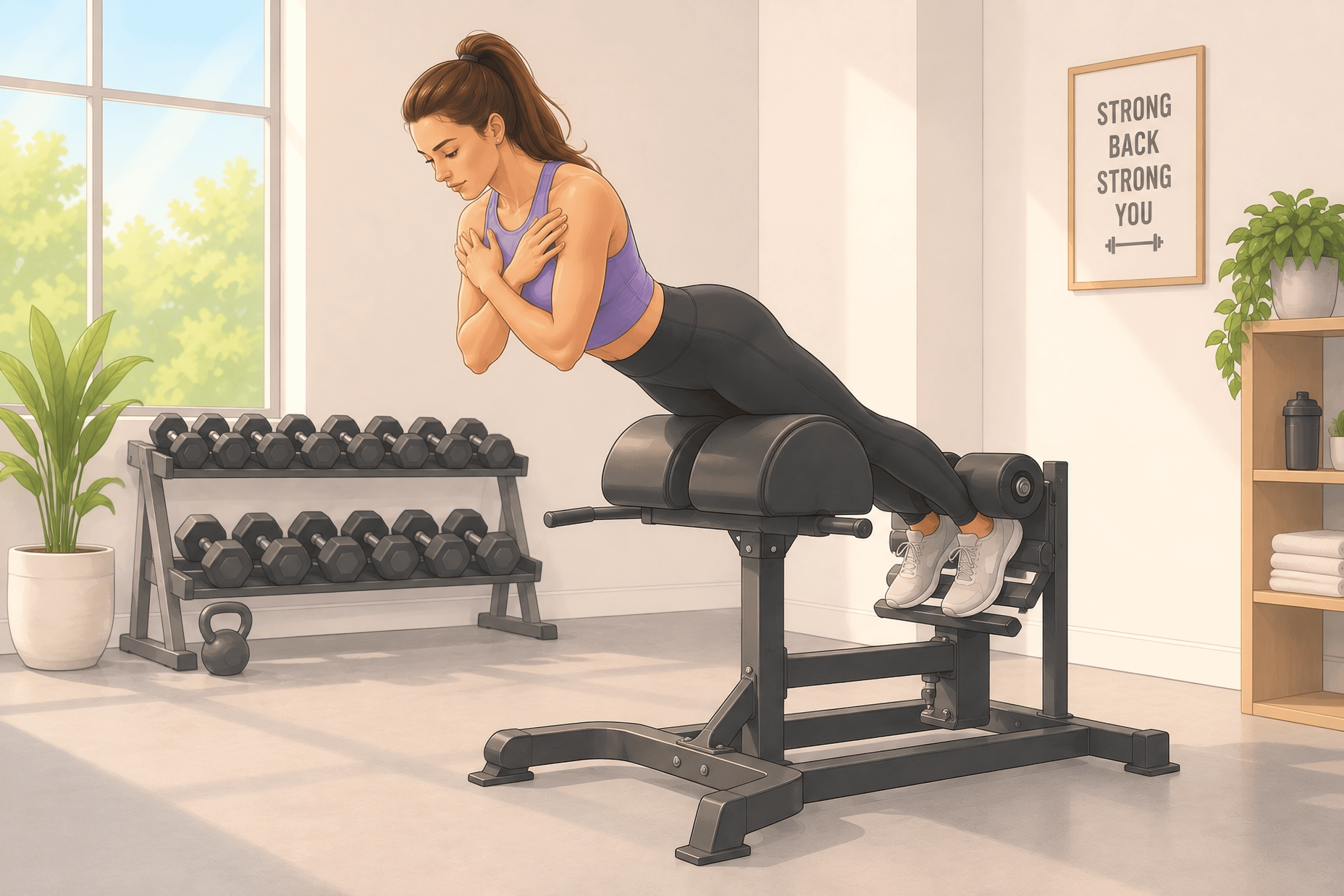
A glute-ham developer (GHD), or glute-ham raise machine, can be a solid alternative to the back hyperextension bench. It actually offers more versatility and places less stress on the knee joints.
The main difference is where your body pivots.
- On a hyperextension bench, you hinge at the hips while your legs stay straight.
- On a glute-ham developer, your feet are secured lower and your knees can bend, allowing both hip extension and knee flexion. That means you can target the hamstrings more directly (by emphasizing the knee-flexion portion) or the glutes and lower back (by focusing on hip extension).
⚠️ Watch Out for Poorly Designed Machines
Some back hyperextension machines position your body in a way that forces your knees into full hyperextension instead of allowing a slight bend. Over time, that can place unwanted stress on the knee joint, especially if you're lifting heavy or performing high-rep sets.
I learned this the hard way. I tore my meniscus while doing back hyperextensions on a machine that locked my knees into an overextended position, despite using good technique otherwise.
If a hyperextension bench doesn't let you keep a slight bend in your knees, consider using a different machine or switching to a glute-ham developer (GHD), which naturally allows for a more knee-friendly position.
If you have access to a glute-ham raise machine, follow the same form cues covered earlier: maintain a neutral spine, let your hips lead the movement, and keep a controlled tempo. Adjust the footplate and knee pad so you can perform the exercise comfortably while emphasizing the muscles you want to target.
That said, a GHD requires more strength than a back hyperextension machine, so it’s not ideal for beginners or anyone still building posterior chain strength.
If you’re just starting out, or your glutes, hamstrings, and lower back aren’t particularly strong yet, stick with the hyperextension bench first. Once you’ve built a solid foundation and learned proper form, the GHD is a great way to level up.
Back Extensions Causing Pain? Try the Reverse Hyperextension.
No single exercise works for everyone—or for every type of back pain. If the standard hyperextension doesn’t feel right for you, there are gentler alternatives that place less strain on the spine and lower back muscles.
One option is the reverse hyperextension. Unlike a standard back extension, where your torso moves and your legs stay fixed, the reverse hyper keeps your upper body still while your legs do the work. This variation reduces movement through the lumbar spine, making the exercise more comfortable for people with lower back pain.
💡 The reverse hyperextension was invented by powerlifting legend Louie Simmons after he suffered a serious back injury. When done correctly, it strengthens the glutes, hamstrings, and spinal erectors while decompressing the spine.
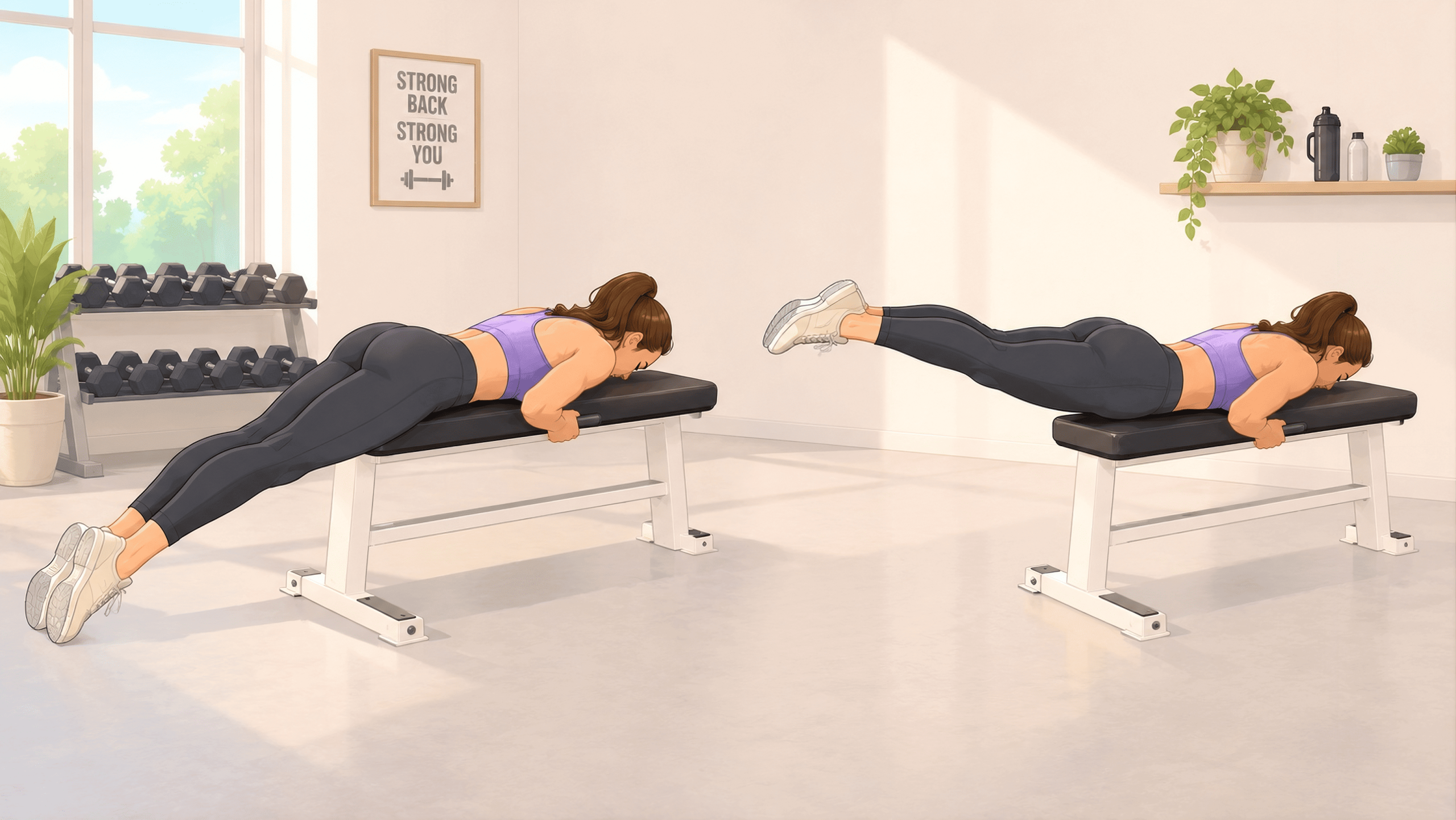
A 2019 study published in the Journal of Strength and Conditioning Research compared the standard back extension to the reverse hyperextension by measuring range of motion, muscle activation, and lower‑back extension moment. Participants performed two sets of 10 reps of each exercise using equivalent loads.
Here’s what the researchers found:
- The standard back extension produced significantly greater activation of the hamstrings (biceps femoris) and glutes compared to the reverse hyperextension.
- The reverse hyperextension generated a notably greater low back moment (peak: +129%, integrated: +63%, mean: +78%) than the standard back extension.
- However, the reverse hyperextension involved significantly less lumbar flexion (20.4° vs. 31.1°) and allowed for greater hip range of motion (76.6° vs. 64.7°).
- Erector spinae activation was roughly equivalent between the two exercises.
To put it simply, the reverse hyperextension shifts more of the movement to your hips and less to your lower back while still giving your spinal extensors a solid workout. If regular back extensions leave your back feeling worse, try this posterior chain exercise to spare your spine.
I’ll soon publish a complete guide to reverse hyperextensions, including proper technique, common mistakes, and who benefits most. For now, just know they’re a worthwhile alternative if standard back extensions don’t feel right for your body.
These Small Tweaks Make a Big Difference
Proper form isn’t always enough to spare your lower back, knees, or whatever joint happens to be giving you trouble. You may also need to adjust the setup, range of motion, and resistance based on how your body is feeling that day.
For example, holding a weight plate against your chest is a good way to progress. But if your lower back is acting up, stick to bodyweight only.
A few small adjustments can make the back hyperextension safer and more effective. Here are the details worth paying attention to:
- Keep a slight bend in your knees. Locking your knees can force them into hyperextension, placing unnecessary stress on the joint. A soft bend keeps the load where it belongs—on your hips, glutes, and lower back.
- Start with bodyweight. Before adding resistance to the back hyperextension, make sure you can go through the full range of motion with perfect form. Otherwise, you might end up rounding at the bottom or arching too far at the top.
- Progress gradually. Once bodyweight feels comfortable for three to four sets of 15 reps, add resistance in small increments. A five- to 10-lb (2.5-5 kg) plate is more than enough to start.
- Add reps before weight. If you’re unsure whether to add load or bump up the reps, increase your reps first. Building strength through controlled volume is often safer than jumping to a heavier load too soon.
- Don’t train through sharp pain. Mild fatigue or muscle soreness is normal, but sharp, shooting, or radiating pain is your body telling you to stop. Pushing through it can turn a manageable issue into a more serious injury. If your lower back is acting up, ease off or skip the exercise entirely that day.
- Squeeze and hold at the top. Once you reach neutral, hold for a second or two and squeeze your glutes. This brief pause reinforces the mind-muscle connection and ensures your glutes, not your lower back, are doing the work.
- Stop at neutral. More range of motion isn’t always better. Once your body forms a straight line, resist the urge to keep lifting. The extra movement likely comes from your lower back rather than your hips, increasing stress on the lumbar spine.
- Don’t yank your head up. Leading with your chin strains the neck and creates a false sense of range of motion. Your neck should stay neutral throughout—pick a spot on the floor ahead of you and keep your eyes on it for the entire rep.
- Remember to breathe. The prone position makes breathing feel awkward, and many people hold their breath without realizing it. Exhale as you lift, inhale as you lower, and keep the rhythm going for the whole set.
- Use small progressions to increase difficulty. Beyond adding weight, you can make the exercise more challenging by adjusting the bench to a steeper angle, performing it from a 90-degree position, or lifting one leg off the footplate. Work on one progression at a time, and make sure your technique stays solid before adding the next.
Again, pay attention to how you feel. Some days, your lower back will tolerate heavier loads or more challenging variations. On others, especially during a flare-up, you may be better off sticking to two or three bodyweight sets.
The Back Hyperextension Deserves a Place in Your Workout
There are days when I go to the gym mostly for the back hyperextension. I’ll do other exercises too, but this one alone makes the trip worthwhile.
Once you learn the proper technique, you’ll understand why it’s so good for your lower back and posterior chain. Ideally, perform it when you’re fully warmed up, either near the end of your workout or as a finisher after training your back or legs.
Need one more reason to make it a regular part of your routine? A strong lower back supports nearly everything you do, in the gym and beyond. Whether you’re squatting, carrying groceries, or working in the garden, stronger spinal extensors help your body move more efficiently and with less pain.
Start with bodyweight, focus on form over ego, and progress gradually. Your lower back doesn’t need countless exercises—just consistent, well-executed ones.
A Note About AI: Some images on Shape Your Energy are created with the help of AI, and I may occasionally use AI tools to refine parts of the text for clarity, flow, or readability.
The content itself is written by me, based on my professional knowledge, experience, research, and original ideas. I don't use AI to generate my articles or replace my own expertise and judgment. Any AI-assisted edits are reviewed and adapted by me before publication.
Back Hyperextension FAQs
Yes, hyperextensions are safe and often beneficial for lower back pain when performed with proper form, controlled range of motion, and appropriate loading. This exercise strengthens the muscles that support your spine, including the erector spinae, glutes, and hamstrings. Stronger posterior chain muscles improve spinal stability and make everyday activities easier.
Problems typically arise from overextending past neutral, using momentum, or lifting too heavy—not from the exercise itself. That said, if you have an acute injury, severe pain, or symptoms like numbness or pain radiating down your leg, hold off until your symptoms subside. Gentle stretching and PT exercises are more suitable during a flare-up.
It depends on the type and severity of the disc issue. Some people with mild disc-related pain tolerate the back hyperextension well, especially with a limited range of motion. Others need to avoid spinal loading altogether. If you have a herniated disc, check with a doctor or physical therapist before adding this exercise to your routine.
Perform hyperextensions two or three times per week, ideally at the end of a back or leg workout. However, even one weekly session can help you strengthen your lower back muscles if done with correct form and as part of a well-rounded training program. I have chronic lower back pain myself, and doing this exercise at least three times a week has significantly improved my symptoms.
It depends on your goal. A neutral spine is the safest option for most people. A slight, controlled rounding of the upper back can increase emphasis on the erector spinae, but excessive rounding or arching the lumbar spine under load should be avoided unless you're following a specific training approach and know exactly what you're doing.
Not directly. The back hyperextension isolates the posterior chain without the full-body loading and grip demands of a deadlift. Still, it's a useful accessory exercise or a lower-impact alternative for building posterior chain strength without heavy axial loading.
A back hyperextension bench keeps your legs straight and hinges you at the hips, while a glute-ham developer (GHD) allows your knees to bend, letting you work through both hip extension and knee flexion. The GHD offers more versatility but requires more strength and is generally considered more advanced.
For some people, yes. Strengthening the muscles that support your lumbar spine can reduce the mechanical stress that aggravates sciatic nerve irritation. However, sciatica has many possible causes, and this exercise isn't right for everyone. Start with bodyweight only, avoid any range of motion that triggers nerve pain (tingling, shooting pain down the leg), and stop immediately if your symptoms worsen.
The back hyperextension targets the erector spinae (spinal extensors), glutes, and hamstrings, with secondary activation of the core and stabilizing muscles.
Aim for three to four sets of 10-15 reps, focusing on strict form. Beginners or anyone managing lower back pain should start with one to two sets and progress gradually.
Yes, hyperextensions can aggravate sciatica or lower back pain if performed with poor form or excessive range of motion. Common mistakes, such as going past neutral, using momentum, or lifting too heavy, place unnecessary stress on the lumbar spine and may worsen existing symptoms. It's also recommended to avoid this exercise during a flare-up, when your lower back is already irritated.
If you don't have access to a back hyperextension machine, try reverse hyperextensions, Romanian deadlifts, bird dogs, good mornings, or stability ball back extensions. The best hyperextension exercise substitute depends on your experience, equipment, and whether you're training for strength, rehab, or general fitness.
Muscle soreness is normal when you're new to this exercise, but sharp or persistent pain isn't. Common causes include arching too far at the top, using too much weight, relying on momentum, or using a poorly adjusted back hyperextension bench. If pain doesn't improve after a few days or worsens during daily activities, stop the exercise and switch to gentler movements.
Generally, after. Doing a back hyperextension workout before squats or deadlifts can fatigue the spinal erectors and reduce stability during your main lifts. As a finisher, hyperextensions help reinforce good hip-hinge mechanics without compromising your heavier compound movements.
Yes. The hyperextension exercise strengthens the muscles responsible for keeping your spine upright, especially the erector spinae. When combined with upper‑back work (rows, face pulls), it can reduce slouching and improve overall posture.
That's usually a sign you're performing the movement correctly. Driving through your hips and squeezing your glutes reduces unnecessary stress on the lumbar spine while still strengthening the muscles that support it. Unless your goal is to specifically emphasize the erector spinae, feeling the exercise in your glutes is usually a good thing.
It depends on which muscles you're targeting. Holding a plate or dumbbell against your chest keeps the load close to your body, shortening the lever arm and placing more emphasis on your lower back (spinal erectors). Extending your arms or letting the weight hang in front of you lengthens that lever arm, shifting more work to your glutes and hamstrings.
A few common placement options:
- Against the chest: Keeps the load close and maximizes lower back involvement—a good choice for most people doing a standard hyperextension exercise.
- Arms extended or hanging down: Increases the challenge for your glutes and hamstrings by lengthening the lever arm, making the movement more demanding at the same weight.
- Behind the neck: Generally not recommended. It places unnecessary stress on your neck and upper back while offering few advantages over holding the weight against your chest.
If you have lower back pain, hold the weight against your chest rather than with your arms extended. Save extended-arm variations for when you've built enough strength to perform every rep with perfect form.